Share
How does the isuzu 4wd and terrain command work?
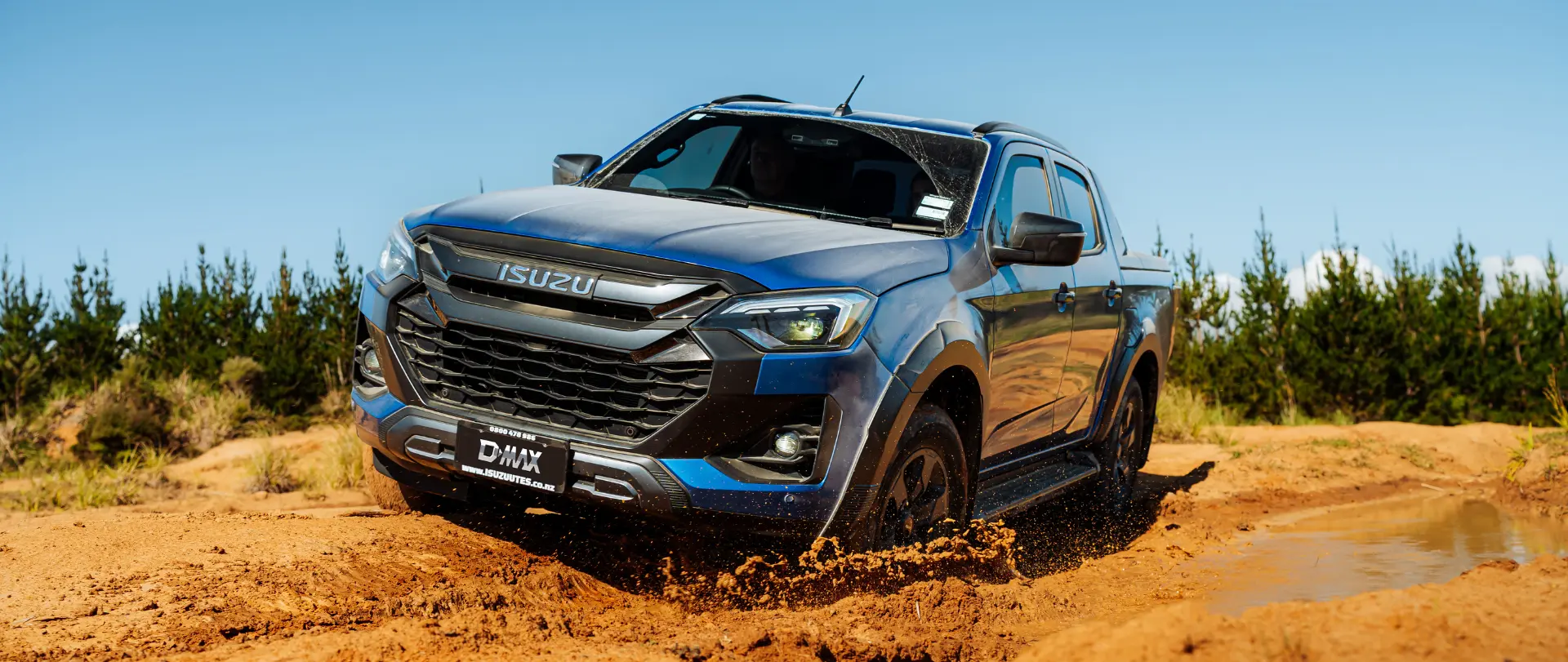
Isuzu's Terrain Command system allows the driver to switch between two-wheel drive and four-wheel drive depending on the driving conditions.
On 4WD D-MAX models and the MU-X, Terrain Command provides 2H (two-wheel drive), 4H (four-wheel drive high) and 4L (four-wheel drive low). The system is designed to provide additional traction when driving on loose, slippery or uneven surfaces.
On the current D-MAX and MU-X, you can switch between 2H and 4H while driving at speeds of up to 100km/h when conditions require additional traction. 4L is used when you need low-speed control and additional drive through more demanding terrain.
What is Terrain Command?
Terrain Command is Isuzu's 4WD control system.
It uses a selector dial to let the driver choose the appropriate drivetrain setting for the conditions.
The main settings are:
- 2H – two-wheel drive for normal road driving
- 4H – four-wheel drive high for surfaces where additional traction is required
- 4L – four-wheel drive low for slow-speed driving in more challenging terrain
The D-MAX and MU-X use a part-time 4WD system, meaning the driver selects 2WD or 4WD depending on the conditions rather than leaving the vehicle permanently in 4WD.
What does 2H mean?
2H means two-wheel drive, high range.
This is the setting used for normal driving on sealed roads and other surfaces where additional four-wheel-drive traction isn't required.
For everyday driving on dry roads, 2H is the appropriate setting.
What does 4H mean?
4H means four-wheel drive, high range.
It sends drive to all four wheels to provide additional traction when conditions become slippery or loose.
4H can be useful on surfaces such as:
- Gravel
- Mud
- Sand
- Wet grass
- Loose or uneven tracks
- Other surfaces where additional traction is needed
On the current D-MAX and MU-X, Terrain Command allows the driver to switch between 2H and 4H on the move at speeds of up to 100km/h.
This means you don't necessarily need to stop the vehicle when a change in road conditions requires four-wheel drive.
What does 4L mean?
4L means four-wheel drive, low range.
Low range changes the gearing to provide greater control and drive at lower speeds. It is intended for more demanding terrain where maintaining a controlled, slow speed is important.
4L can be useful for situations such as:
- Steep climbs
- Steep descents
- Deep mud
- Deep sand
- Rocky or uneven terrain
- Slow-speed off-road driving
The D-MAX and MU-X use a 2.482:1 low-range transfer ratio, compared with 1.000:1 in high range.
Because 4L is designed for low-speed driving, it isn't intended for normal road use.
When should you use 4WD?
The simplest way to think about it is:
Use 2H for normal sealed-road driving.
Use 4H when you need additional traction on loose or slippery surfaces.
Use 4L when you need low-speed control and additional drive through more demanding terrain.
The appropriate setting depends on the surface, conditions and speed you're travelling at.
Can you switch from 2WD to 4WD while driving?
Yes. The current D-MAX and MU-X Terrain Command systems allow you to switch between 2H and 4H on the move at speeds of up to 100km/h if you are driving on unsealed roads.
This is sometimes referred to as "shift on the fly."
The ability to change between 2H and 4H while moving is useful when road conditions change, such as moving from a sealed road onto a gravel track.
4L is different and is intended for low-speed, more demanding terrain.
What is Rough Terrain Mode?
Rough Terrain Mode is a traction-enhancement system available on the latest 4WD D-MAX models and the MU-X.
On the D-MAX, Isuzu describes Rough Terrain Mode as working with the rear differential lock to enhance traction.
It is designed to help when driving over difficult surfaces where one or more wheels may have limited traction.
Rough Terrain Mode should be considered an additional aid alongside the vehicle's 4WD system rather than a replacement for selecting the appropriate 4WD range.
What does the rear differential lock do?
The rear differential lock helps provide additional traction by locking the rear differential so that the rear wheels turn together.
It can be useful when one rear wheel has significantly less traction than the other, such as on uneven or slippery terrain.
The current D-MAX 4WD system combines 4L with a rear differential lock for more demanding off-road conditions.
Does 4WD make a D-MAX or MU-X unstoppable?
No. Four-wheel drive can improve traction, but it doesn't remove the physical limits of the vehicle or the conditions you're driving in.
Factors such as tyres, ground clearance, water depth, gradient, surface conditions and driving technique all affect how a vehicle performs off-road.
The current D-MAX and MU-X have a maximum listed wading depth of 800mm, but water crossings still need to be approached carefully and within the vehicle's specified limits.
What is Hill Descent Control?
Hill Descent Control (HDC) is designed to help control the vehicle's speed when travelling down steep terrain.
The system automatically applies the brakes to help maintain a controlled descent, reducing the need for the driver to constantly apply the brake pedal.
It can be particularly useful when travelling slowly down steep or uneven surfaces.
Does the MU-X have the same 4WD system as the D-MAX?
The D-MAX and MU-X both use Terrain Command with 2H, 4H and 4L settings.
Both allow 2H ↔ 4H selection on the move at up to 100km/h and have 4L for low-speed driving in more demanding terrain. The MU-X also has Rough Terrain Mode and a rear differential lock.
The key difference is the vehicle itself: the D-MAX is a ute, while the MU-X is a seven-seat SUV.
Is 4WD the same as AWD?
No.
4WD (four-wheel drive) and AWD (all-wheel drive) are different drivetrain systems.
The Isuzu D-MAX and MU-X use a selectable 4WD system with different high- and low-range settings. This gives the driver control over when four-wheel drive is engaged and allows the use of low range for demanding terrain.
AWD systems generally operate differently, with power distribution managed automatically depending on the vehicle and system.
Terrain Command FAQs
Can I use 4H on the highway?
Terrain Command allows 2H and 4H to be selected on the move at up to 100km/h, but 4WD should be used according to the road and surface conditions. For normal sealed-road driving, 2H is the appropriate setting.
Can I use 4L on sealed roads?
4L is intended for low-speed driving in demanding terrain rather than normal sealed-road driving. It provides low-range gearing for situations where additional control and drive are required.
Does every D-MAX have 4WD?
No. The current D-MAX range includes both 4x2 and 4x4 models. Four-wheel-drive availability depends on the specific model and configuration.
What tyres are best for 4WD driving?
The right tyres depend on how and where the vehicle is used. Highway-terrain, all-terrain and mud-terrain tyres have different characteristics, so tyre choice should reflect the surfaces and conditions the vehicle regularly encounters.
The simple answer
Isuzu Terrain Command gives the driver control over the D-MAX or MU-X's 4WD system.
Use 2H for normal driving, 4H when additional traction is needed on loose or slippery surfaces, and 4L for slow-speed driving through more demanding terrain.
On the current D-MAX and MU-X, 2H and 4H can be selected on the move at up to 100km/h, while 4L, Rough Terrain Mode and the rear differential lock provide additional capability when conditions become more challenging.