Share
How much can an isuzu d-max or mu-x tow?
a guide to towing in new zealand
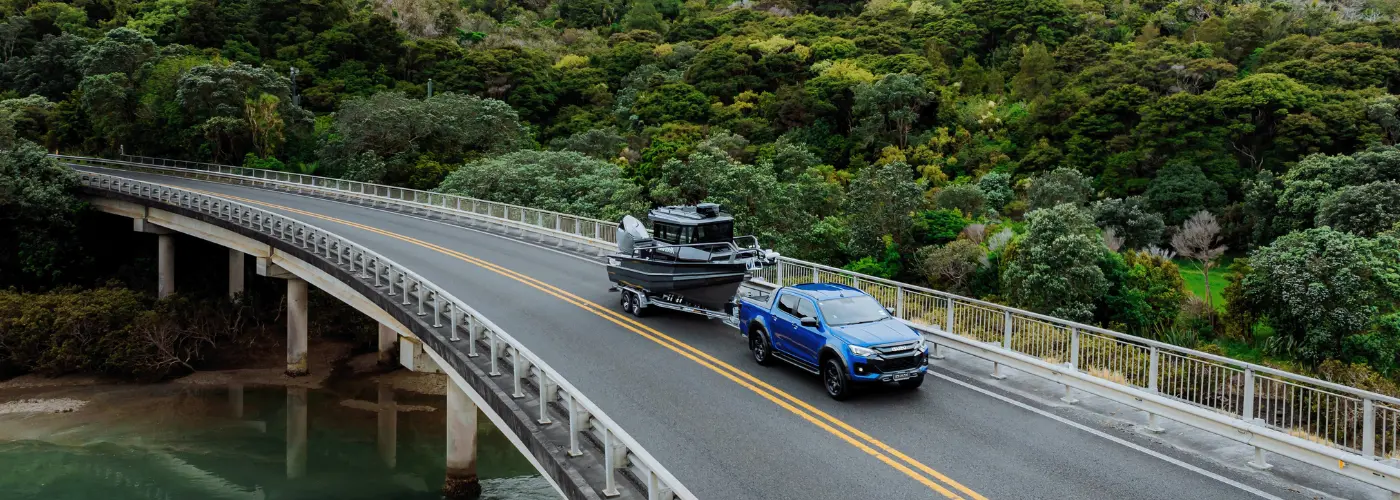
Whether you're towing a boat to the ramp, a caravan away for the weekend or a trailer for work, knowing what your vehicle can tow is important.
Both the Isuzu D-MAX and MU-X can tow up to 3,500kg with a braked trailer, making them capable options for a wide range of towing jobs. Both are also rated to tow up to 750kg with an unbraked trailer and have a maximum tow-ball download of 350kg when fitted with the genuine Isuzu UTE tow kit.
But towing capacity isn't the only number to consider. The weight of your trailer, what's loaded into it, the weight of passengers and gear, and the vehicle's GVM and GCM all need to be taken into account.
How much can a D-MAX tow?
The current Isuzu D-MAX has:
- 3,500kg maximum braked towing capacity
- 750kg maximum unbraked towing capacity
- 350kg maximum tow-ball download when fitted with the genuine Isuzu UTE tow kit
- 3,100kg GVM
- 6,000kg GCM
A 3,500kg braked towing capacity means the D-MAX can tow a trailer with a maximum loaded weight of 3,500kg when the trailer is fitted with its own braking system.
It's important to consider the loaded weight, not just the empty weight of the trailer. For example, if you're towing a boat, the total weight includes the boat, trailer, fuel, batteries and equipment.
How much can an MU-X tow?
The MU-X is a 7-seat SUV, but it still offers serious towing capability.
The current MU-X has:
- 3,500kg maximum braked towing capacity
- 750kg maximum unbraked towing capacity
- 350kg maximum tow-ball download when fitted with the genuine Isuzu UTE tow kit
- 2,800kg GVM
- 5,900kg GCM
So while the D-MAX and MU-X have the same maximum braked towing capacity, their other weight ratings are different. This is important when working out how much you can carry in the vehicle while towing.
What does 3,500kg braked towing mean?
A 3,500kg braked towing capacity means the vehicle is rated to tow a trailer with a maximum loaded weight of 3,500kg when the trailer has its own braking system.
In New Zealand, trailer brake requirements depend on the laden weight of the trailer. NZTA states that service brakes are required on trailers over 2,000kg, with additional requirements applying to trailers between 2,501kg and 3,500kg.
Always check the current requirements for your particular trailer before towing.
Can a D-MAX or MU-X tow a caravan?
Yes. Both the D-MAX and MU-X can tow caravans within their rated towing capacity.
However, a caravan's advertised weight isn't necessarily its weight once you're ready to hit the road. Water, gas, food, luggage and other equipment can all add to the loaded weight.
You also need to consider:
- The loaded weight of the caravan
- Passengers and cargo in the vehicle
- Tow-ball download
- GVM
- GCM
- The rated capacity of the towbar and trailer
If you're towing close to the vehicle's limits, having the complete combination weighed is a good way to make sure you're within the relevant ratings.
Can a D-MAX or MU-X tow a boat?
Yes. Both are well suited to towing boats, provided the loaded boat and trailer combination is within the vehicle's towing and weight limits.
Remember to include the trailer, fuel, batteries and equipment when working out the total weight.
Correct loading is also important. Keeping weight distributed appropriately through the trailer can help maintain stability when towing.
What are GVM and GCM?
Two important terms to understand when towing are GVM and GCM.
GVM (Gross Vehicle Mass) is the maximum permitted weight of the vehicle when loaded. This includes passengers, fuel, accessories, cargo and the weight imposed on the vehicle by the trailer.
The D-MAX has a 3,100kg GVM, while the MU-X has a 2,800kg GVM.
GCM (Gross Combination Mass) is the maximum combined weight of the vehicle and trailer.
The D-MAX has a 6,000kg GCM, while the MU-X has a 5,900kg GCM.
This means you can't simply take the 3,500kg towing capacity and add it to the vehicle's GVM. The complete combination still needs to remain within the applicable GCM.
What is tow-ball download?
Tow-ball download is the downward force the trailer places on the vehicle's tow ball.
Both the D-MAX and MU-X have a maximum tow-ball download of 350kg when fitted with the genuine Isuzu UTE tow kit.
Correct trailer loading is important for stability, so make sure the load is distributed appropriately and that you stay within the limits of the vehicle, towbar and trailer.
D-MAX or MU-X: which is better for towing?
Both offer a 3,500kg braked towing capacity, so the right choice comes down to what you need the vehicle to do when you're not towing.
D-MAX is the natural choice if you need a ute for work, carrying equipment and loads, while still wanting the ability to tow a caravan, boat or trailer.
MU-X gives you the same 3,500kg braked towing capability in a seven-seat SUV, making it a practical option if your priorities are family, passengers and towing.
Both use Isuzu's 3.0L turbo-diesel engine and are designed to handle a mix of everyday driving, work and towing.
What should I check before towing?
Before heading out, make sure:
- Your trailer's loaded weight is within the vehicle's towing capacity
- The vehicle's GVM and GCM aren't exceeded
- Tow-ball download is within the applicable limit
- Your towbar and coupling are correctly rated
- The trailer's brakes are working correctly
- Your load is secure and distributed appropriately
- Safety chains or cables are correctly attached
- Your trailer has a current WoF and registration
NZTA also sets requirements for light trailers, including braking, safety chains and other equipment.
D-MAX and MU-X towing FAQs
How much can an Isuzu D-MAX tow?


The current D-MAX has a maximum braked towing capacity of 3,500kg and a maximum unbraked towing capacity of 750kg.
How much can an Isuzu MU-X tow?
The current MU-X has a maximum braked towing capacity of 3,500kg and a maximum unbraked towing capacity of 750kg.
Can an MU-X tow a 3.5-tonne caravan?
The MU-X has a maximum braked towing capacity of 3,500kg. However, the loaded vehicle and trailer combination must remain within all applicable vehicle, trailer and legal limits.
What is the difference between D-MAX and MU-X towing?
Both have a 3,500kg maximum braked towing capacity. The D-MAX has a 3,100kg GVM and 6,000kg GCM, while the MU-X has a 2,800kg GVM and 5,900kg GCM.
What is the maximum tow-ball download on a D-MAX or MU-X?
Both have a maximum tow-ball download of 350kg when fitted with the genuine Isuzu UTE tow kit.
Ready to tow?
From the boat ramp to the job site, both the D-MAX and MU-X are built to handle serious towing.
With 3,500kg braked towing capacity, a 3.0L turbo-diesel engine and towing-focused features including Trailer Sway Control, both give you plenty of capability for work, family and weekends away.
Explore the D-MAX and MU-X range to find the right Isuzu for you.
*GVM & GCM figures are applicable to 4x4 variants. 4x2 variants have a 3,000kg GVM & 5,850kg GCM rating.