Share
How Much Can a D-MAX Carry? Understanding Payload
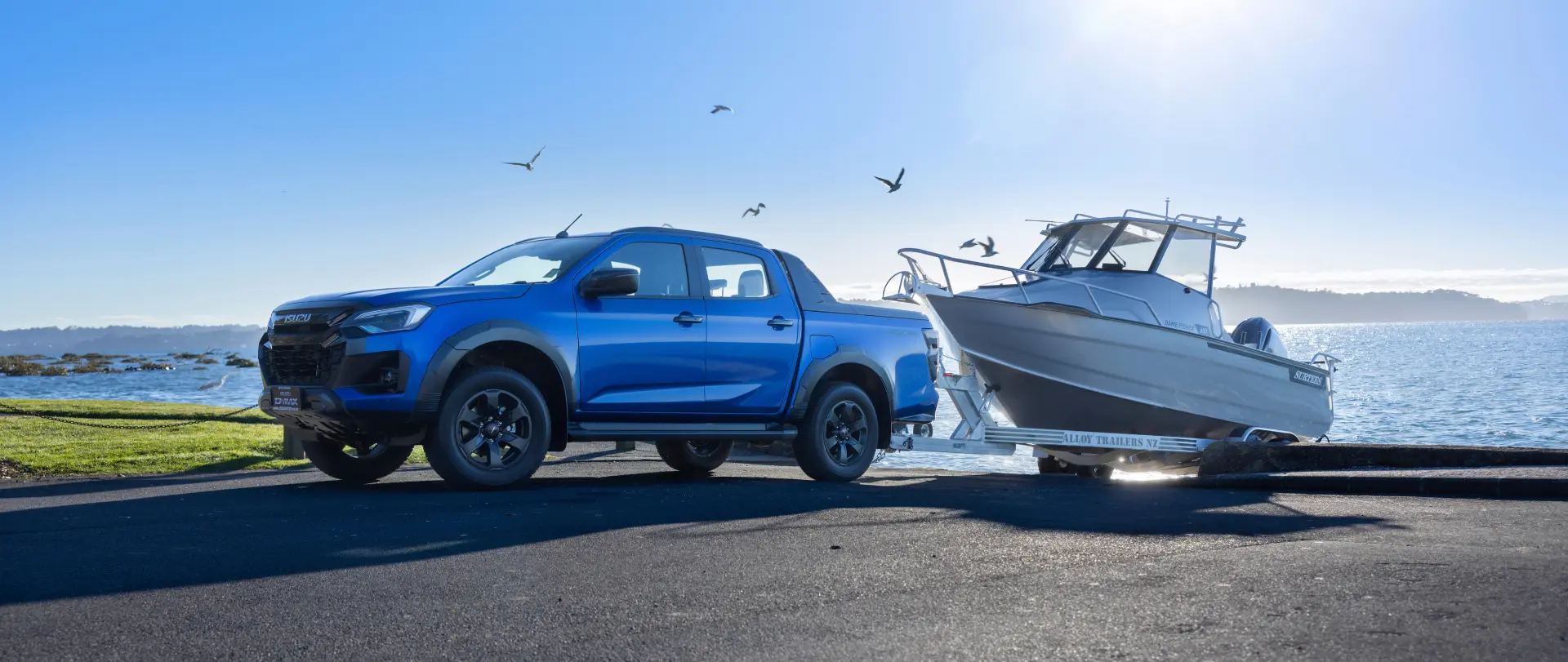
The amount an Isuzu D-MAX can carry depends on the model and configuration. Current D-MAX cab-chassis payload figures range from 990kg to 1,310kg.
Payload is the total weight you can add to the vehicle, including passengers, fuel, accessories, tools, equipment and cargo. It is different from towing capacity, which is up to 3,500kg for a braked trailer.
What is the payload of a D-MAX?
The payload of a D-MAX varies between models and configurations.
Current D-MAX payload figures include:
|
D-MAX configuration |
Listed payload |
|
LX Single Cab Chassis |
1,310kg |
|
LX Space Cab Chassis |
1,245kg |
|
LX Double Cab Wellside |
1,065kg |
|
LS Wellside |
995kg |
The D-MAX LX has a GVM of 3,100kg. The difference in payload between configurations is largely due to differences in the vehicle's kerb weight. (isuzuutes.co.nz)
These figures relate to the specified cab-chassis configurations. Once a tray, body or other equipment is fitted, the weight of those additions needs to be accounted for.
What does payload mean?
Payload is the amount of additional weight a vehicle can carry while remaining within its specified GVM.
For a D-MAX, this can include:
- Driver and passengers
- Fuel
- Tools and equipment
- Cargo
- Tray or body
- Canopy or hard lid
- Bull bar
- Towbar
- Roof racks
- Other accessories
This means a listed payload figure isn't necessarily the amount of cargo you can put in the tray.
For example, if a vehicle has a 1,000kg payload, the combined weight of its passengers, accessories, fuel and cargo needs to remain within that available payload.
How is D-MAX payload calculated?
Payload is based on the difference between the vehicle's GVM and its kerb weight.
GVM − kerb weight = payload
For example, the D-MAX LX Single Cab Chassis has a listed GVM of 3,100kg and kerb weight of 1,790kg, giving it a listed payload of 1,310kg.
The LX Double Cab Wellside has the same 3,100kg GVM but a higher listed kerb weight of 2,035kg, giving it a 1,065kg payload. (isuzuutes.co.nz)
This is why a D-MAX with more passenger space doesn't necessarily have the same payload as a lower-weight configuration.
How much weight can you actually put in the tray?
There's no single figure that applies to every D-MAX.
The maximum cargo weight depends on the specific vehicle's available payload after accounting for the weight of everything else being carried or fitted to it.
For example, a Single Cab D-MAX with a listed 1,310kg payload won't necessarily have 1,310kg available for cargo once a tray, canopy, accessories, fuel and passengers are included.
The actual weight of the vehicle and its equipment needs to be considered when determining how much cargo can be carried.
Do accessories reduce payload?
Yes.
Anything permanently added to the vehicle contributes to its overall weight and therefore reduces the payload remaining for cargo.
This can include items such as:
- Canopies
- Bull bars
- Towbars
- Roof racks
- Winches
- Trays and bodies
- Other accessories
This is particularly important for a cab-chassis D-MAX, where the final vehicle weight will depend on the tray or body fitted.
How does towing affect payload?
Towing capacity and payload are separate ratings, but they can affect each other.
The current D-MAX has a maximum braked towing capacity of 3,500kg, a GVM of up to 3,100kg and a GCM of up to 6,000kg. (isuzuutes.co.nz)
When a trailer is attached, the weight imposed on the vehicle through the tow ball contributes to the vehicle's loaded weight.
This means you can't simply take the D-MAX's maximum payload and add a 3,500kg trailer on top. The vehicle's GVM, GCM, towing capacity and tow-ball download all need to be considered together.
For more information, see How Much Can an Isuzu D-MAX or MU-X Tow? A Guide to Towing in New Zealand.
What is the difference between payload and GVM?
Payload is the amount of additional weight the vehicle can carry.
GVM (Gross Vehicle Mass) is the maximum permitted total weight of the loaded vehicle.
So, if a D-MAX has a GVM of 3,100kg, its driver, passengers, fuel, accessories and cargo must collectively keep the vehicle within that limit.
For a broader explanation of vehicle weight ratings, see What Is GVM, GCM and Payload? A Simple Guide for Ute Owners.
Which D-MAX has the highest payload?
The current LX Single Cab Chassis has the highest listed payload at 1,310kg.
The LX Space Cab Chassis is listed at 1,240kg, the LX Double Cab Wellside at 1,065kg, and the LS Wellside at 995kg. (isuzuutes.co.nz)
D-MAX payload FAQs
Does a D-MAX payload include fuel?
Yes. Fuel is part of the vehicle's loaded weight and therefore needs to be accounted for within the available payload.
Does a D-MAX payload include the tray?
For a cab-chassis vehicle, the tray or body fitted to the vehicle adds weight. That weight therefore reduces the payload remaining for other items.
Does D-MAX payload change with different cab configurations?
Yes. Different cab configurations have different kerb weights, which results in different payload ratings even where the GVM is the same.
Where can I check the exact payload for my D-MAX?
Check the specifications for your exact model and configuration, as well as the vehicle's compliance information. If you're regularly carrying heavy loads or operating close to the vehicle's weight limits, weighing the loaded vehicle is the most reliable way to determine its actual weight.
The simple answer
A D-MAX can carry up to 1,310kg based on the highest current listed cab-chassis payload, but the exact amount depends on the model, configuration and what has been fitted or loaded onto the vehicle.
Remember that payload includes more than what's sitting in the tray. Passengers, fuel, accessories, the tray or body and cargo all contribute to the vehicle.