Share
What is gvm, gcm and payload?
a simple guide for ute owners
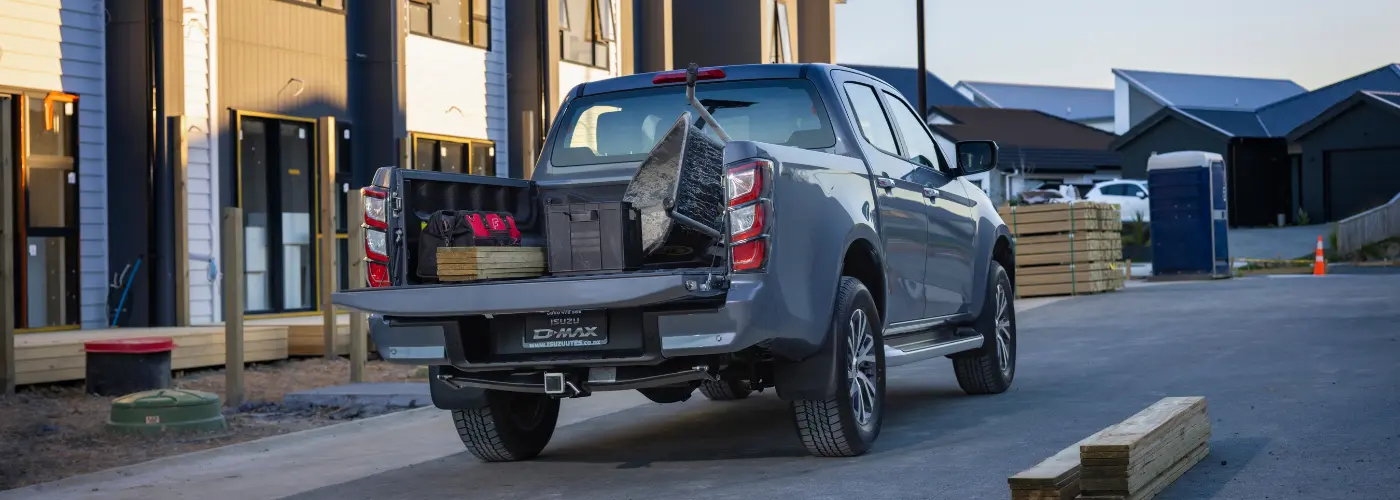
If you're buying a ute, towing a trailer or loading up for work, you'll probably come across three numbers: GVM, GCM and payload.
But what do they actually mean?
In simple terms:
- GVM is the maximum weight of the vehicle when loaded.
- GCM is the maximum combined weight of the vehicle and trailer.
- Payload is how much weight you can carry in the vehicle.
Understanding these limits is important because you need to stay within the vehicle's rated limits when carrying passengers, cargo, equipment, accessories or towing a trailer.
What is GVM?
GVM stands for Gross Vehicle Mass.
It is the maximum total weight your vehicle is designed and rated to carry when it is loaded.
That includes the vehicle itself, plus things such as:
- The driver and passengers
- Fuel
- Tools and equipment
- Cargo
- Accessories
- The weight transferred onto the vehicle by a trailer
For the current Isuzu D-MAX, the GVM is 3,000kg for 4x2 variants and 3,100kg for 4x4 variants. The current MU-X has a GVM of 2,800kg.
So, if you have a D-MAX with a GVM of 3,100kg, the total actual weight of the vehicle when loaded must not exceed 3,100kg.
GVM is a vehicle limit — it's not the same thing as the vehicle's towing capacity.
What is payload?
Payload is the amount of weight you can add to the vehicle.
A simple way to think about it is:
Payload = GVM − vehicle's kerb weight
However, the actual available payload can vary depending on the vehicle specification and what has been fitted to it.
For example, the current D-MAX LX specifications list different kerb weights and payload figures across the Single, Space and Double Cab chassis variants. The listed payload figures range from 1,065kg to 1,310kg, with the final payload for cab chassis models depending on the body fitted.
The current MU-X specification lists a 625kg payload.
What counts towards payload?
It's not just what's sitting in the tray.
Your payload can include:
- People in the vehicle
- Luggage
- Tools
- Work equipment
- Accessories
- Bull bars
- Canopies
- Roof racks
- Towbar equipment
- The load imposed on the vehicle by a trailer
This is why adding accessories can reduce the amount of payload you have left for your gear.
What is GCM?
GCM stands for Gross Combination Mass.
It's the maximum combined mass of the towing vehicle and trailer combination.
In other words, when you're towing, you need to consider the weight of both the vehicle and trailer, rather than looking at the trailer's weight on its own.
A current D-MAX 4x4 has a 6,000kg GCM, while the MU-X has a 5,900kg GCM.
For example, if a D-MAX has a GCM of 6,000kg, the combined actual mass of the loaded D-MAX and loaded trailer must stay within that limit.
Waka Kotahi NZ Transport Agency also states that vehicle manufacturer ratings such as GVM and GCM must not be exceeded.
What's the difference between GVM, GCM and payload?
The easiest way to remember them is:
|
Term |
What it means |
D-MAX example |
|
GVM |
Maximum weight of the loaded vehicle |
3,100kg |
|
Payload |
How much weight can be added to the vehicle |
Varies by variant |
|
GCM |
Maximum combined weight of vehicle and trailer |
6,000kg |
For the MU-X, the current figures are 2,800kg GVM, 625kg payload and 5,900kg GCM.
Does towing affect your payload?
Yes.
This is an important point that is sometimes overlooked.
When you connect a trailer, some of the trailer's weight is transferred through the tow ball onto the vehicle.
That means the trailer isn't simply something sitting completely separately behind the ute. The weight it places on the vehicle needs to be considered when working out how heavily the vehicle itself is loaded.
For the current D-MAX and MU-X, the maximum towing capacity with a braked trailer is 3,500kg.
So if you're towing, you need to consider your GVM, GCM, towing capacity and towing capacity together.
Does a 3,500kg towing capacity mean I can always tow 3,500kg?
Not necessarily.
Both the current D-MAX and MU-X have a maximum 3,500kg braked towing capacity, but that doesn't mean you can simply load the vehicle to its GVM and then add a 3,500kg trailer.
You still need to stay within the vehicle's GCM and all other applicable ratings including respecting the download weight of
For example:
D-MAX
- GVM: 3,100kg
- GCM: 6,000kg
- Maximum braked towing: 3,500kg
MU-X
- GVM: 2,800kg
- GCM: 5,900kg
- Maximum braked towing: 3,500kg
The numbers work together, rather than being separate limits you can simply add together.
What happens if I exceed my GVM?
Exceeding the vehicle's rated GVM means you're operating outside the manufacturer's specified vehicle limit.
This can affect the vehicle's handling, braking and overall stability, as well as putting additional load on components such as the suspension, tyres and chassis.
Waka Kotahi states that you must not exceed the vehicle ratings specified by the manufacturer for the chassis, axles, tyres and other components.
It's therefore worth knowing your vehicle's limits before loading it up, particularly if you regularly carry heavy tools, equipment or accessories.
How do I know how much my ute weighs?
If you're unsure about how much your loaded ute weighs, a weighbridge can give you an actual figure.
This can be particularly useful if you've added accessories, regularly carry heavy equipment or are towing a large trailer.
Waka Kotahi notes that operating gross mass can be determined by adding the tare mass to the load being carried, while a weighbridge can be used to measure the actual mass.
Remember that your vehicle's actual weight can change depending on what's in it.
A ute that is within its limits when empty can be much closer to its GVM once it's loaded with passengers, tools, accessories and equipment.
What should I check before loading or towing?
Before heading out, it's worth checking:
- Your vehicle's GVM
- Your vehicle's GCM if towing
- Your available payload
- The loaded weight of your trailer
- Your maximum towing capacity
- Your maximum tow-ball download
- The rating of your towbar and towing equipment
- Your tyres and their load rating
- That your load is properly secured and distributed
If you're regularly towing or carrying heavy loads, weighing the complete setup can be a good way to confirm you're operating within the relevant limits.
GVM, GCM and Payload FAQs
What does GVM mean on a ute?


GVM means Gross Vehicle Mass. It is the maximum permitted mass of the loaded vehicle, including passengers, fuel, equipment, accessories and load.
What does GCM mean on a ute?
GCM means Gross Combination Mass. It is the maximum combined mass of the towing vehicle and trailer combination.
What is payload?
Payload is the amount of weight that can be carried by the vehicle. It includes passengers, fuel, equipment, accessories and cargo.
Is payload the same as towing capacity?
No. Payload is how much weight you can carry in the vehicle, while towing capacity is how much weight the vehicle is rated to tow.
What is the D-MAX GVM?
The current D-MAX has a GVM of 3,100kg for 4x4 variants and 3,000kg for 4x2 variants.
What is the MU-X GVM?
The current MU-X has a 2,800kg GVM.
What is the D-MAX GCM?
The current D-MAX has a 6,000kg GCM.
What is the MU-X GCM?
The current MU-X has a 5,900kg GCM.
How much can a D-MAX or MU-X tow?
Both the current D-MAX and MU-X have a maximum 3,500kg braked towing capacity and 750kg unbraked towing capacity, subject to the applicable vehicle and trailer limits.
Understanding your ute's limits
GVM, GCM and payload can seem confusing at first, but they all come down to the same thing: knowing how much weight your vehicle can safely carry and tow.
If you're using your D-MAX or MU-X for work, towing, or carrying a lot of equipment, understanding these numbers can help you choose the right vehicle and make sure you're staying within its rated limits.
For more information, check the specifications for your D-MAX or MU-X, or speak to your local Isuzu Utes dealer.