Share
D-MAX vs MU-X: What's the Difference?
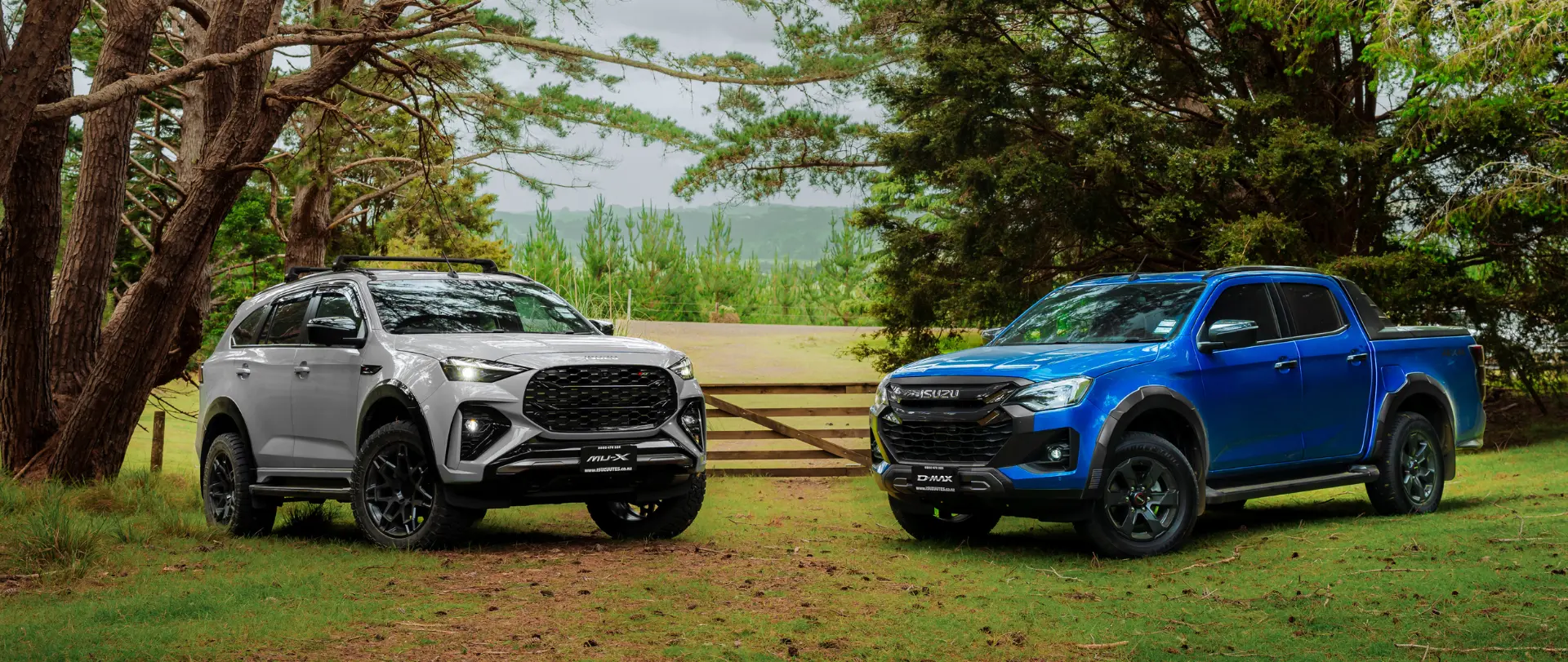
The biggest difference between the Isuzu D-MAX and MU-X is simple: the D-MAX is a ute, while the MU-X is a seven-seat SUV.
Both use Isuzu's 3.0L turbo-diesel 4JJ3 engine and both can tow up to 3,500kg with a braked trailer. But they are designed for different types of use.
The D-MAX is built around carrying loads, equipment and passengers, while the MU-X is designed to carry people and luggage in a seven-seat SUV.
D-MAX vs MU-X: what's the difference?
|
D-MAX |
MU-X |
|
|
Vehicle type |
Ute |
7-seat SUV |
|
Engine |
4JJ3-TCX 3.0L turbo-diesel |
4JJ3-TCX 3.0L turbo-diesel |
|
Seating |
2–5, depending on configuration |
7 |
|
Braked towing capacity |
Up to 3,500kg |
Up to 3,500kg |
|
GVM |
Up to 3,100kg |
2,800kg |
|
GCM |
Up to 6,000kg |
5,900kg |
|
Drivetrain |
2WD and 4WD options |
4WD |
|
Load space |
Open ute tray |
Enclosed cargo area |
Specifications vary by model and configuration.
The D-MAX is a ute
The D-MAX is designed for people who need the flexibility of a ute.
The current range includes Single Cab, Space Cab and Double Cab configurations. This means there are different options depending on how much passenger space and load-carrying capability you need.
The D-MAX's open tray can be used for tools, equipment, materials and other loads, with different tray and body configurations available.
The range also includes 2WD and 4WD options.
For a closer look at the different cab configurations, see D-MAX Single Cab vs Space Cab vs Double Cab: What's the Difference
The MU-X is a seven-seat SUV
The MU-X is designed around carrying passengers, with seven seats across three rows.
The third row can be folded flat when you need more room for luggage or other cargo, giving the MU-X flexibility beyond carrying seven people.
It's also designed for towing and touring, with a maximum braked towing capacity of 3,500kg.
So while the D-MAX gives you an open tray, the MU-X gives you an enclosed interior with three rows of seating.
Do the D-MAX and MU-X have the same engine?
Yes. Both use Isuzu's 4JJ3-TCX 3.0L turbo-diesel engine.
The engine produces 140kW and 450Nm in the current D-MAX range, with the 3.0L turbo-diesel also used in the MU-X. Both use a six-speed automatic transmission.
This means the choice between the two isn't about choosing between different engine sizes. It's primarily about the type of vehicle and how you intend to use it.
Can both tow 3,500kg?
Yes. Both the D-MAX and MU-X have a maximum 3,500kg braked towing capacity and 750kg maximum unbraked towing capacity.
Both also have a maximum tow-ball download of 350kg when fitted with the genuine Isuzu UTE tow kit.
Their other weight ratings are different, however.
The D-MAX has a GVM of up to 3,100kg and GCM of up to 6,000kg, while the MU-X has a GVM of 2,800kg and GCM of 5,900kg.
If you're comparing the two specifically for towing, it's important to consider GVM and GCM as well as the headline 3,500kg towing figure.
Read more: How Much Can an Isuzu D-MAX or MU-X Tow? A Guide to Towing in New Zealand
Which has more room?
Again, it depends on what you need to carry.
The D-MAX has an open load area, which makes it useful for carrying work gear, tools, equipment and larger items.
The MU-X has an enclosed passenger compartment with three rows of seating. With the third row folded, you can create additional interior cargo space.
So the D-MAX is better suited to carrying loads that belong in a ute tray, while the MU-X is designed around passengers and enclosed luggage space.
Which is better for work?
The D-MAX is the more practical option if carrying equipment, materials or other loads is a regular part of your day.
Its different cab configurations also make it possible to prioritise load space or passenger seating depending on the model.
For example, the D-MAX LX is available as a Single Cab, Space Cab or Double Cab, with cab chassis options available for different tray and body setups.
Which is better for families?
The MU-X is designed specifically around passenger space, with seven seats and three rows.
That makes it suited to families who need to carry several passengers while still having the ability to tow a caravan, boat or trailer.
The MU-X also has a 60:40 split-fold second row and 50:50 split-fold third row, allowing the interior to be configured for different combinations of passengers and cargo.
What about four-wheel driving?
Both vehicles offer four-wheel-drive capability, but the systems are used in different vehicle formats.
The D-MAX 4x4 uses Isuzu's Terrain Command system, which allows the driver to switch between 2WD and 4WD Hi on the move at speeds of up to 100km/h. Four-wheel-drive D-MAX models also have Rough Terrain Mode.
The MU-X is available with 4WD and Terrain Command, making it capable of moving between everyday road driving and more challenging terrain when required.
Which one should you choose?
The difference really comes down to what you need the vehicle to do.
The D-MAX is suited to you if you need:
- An open ute tray
- Space for tools, equipment or materials
- Different cab configurations
- A vehicle for work, farming or trade use
- 2WD or 4WD options
- Towing capability alongside load-carrying ability
The MU-X is suited to you if you need:
- Seven seats
- Three rows of passengers
- Enclosed luggage and cargo space
- A vehicle for family use and touring
- 4WD capability
- Up to 3,500kg braked towing capacity
Both share the same 3.0L turbo-diesel engine and 3,500kg maximum braked towing capacity, but the D-MAX and MU-X are built around different priorities.
D-MAX = ute and load carrying.
MU-X = seven-seat SUV and passenger carrying.